Monday, September 10, 2012

Wednesday, September 5, 2012
Where I'm From Poem
I am from open grasslands, from canned goods, and home cooked meals.
I am from the suburban house with a big white porch and golden door.
I am from the perseverance within the pedals of the unmistakable flower, the hydrangea.
I am from church services on Sunday mornings and a room full of love from Maines, Townsends, and Nagys.
I am from the tradition of Dicarlo’s Pizza on Saturdays and a line of practical jokers.
From hearing “Time heals all” from momma and nana’s infamous line,“Because I said so…”
I am from a Presbyterian church downtown on Main Street.
I'm from Steubenville, Ohio, from Germany, and from Hungary, who eats papa’s famous Hungarian Stuffed Peppers for mom’s birthday dinner and German Chocolate Cake for dessert.
From the Christmas Eve gatherings where Uncle Rob-Rob wore his patched up flannel, the day I graduated high school, and the many cheerleading competitions I competed in, mom prepared me for, and dad supported me in.
I am from family trips to exciting theme parks in the summer and the beautiful Snowshoe Mountains in the winter. Yet, I’m just as content snuggled up with my family in the comfort of my own home. I am from a family who protects me and supports me. I am from a family where we remain faithful and true to one another and to God. I am from a family of fighters who have found beauty and strength in even the most troublesome times.
Wednesday, August 29, 2012
Double Journal Entry #3

Reading instruction at an elementary level aids
to poor literacy attainment for older children. This is due to the fact that a
majority of the attention is placed on the reading process
–overlooking/neglecting the purpose of reading (whether it is to generate
ideas, grasp concepts, or obtain information). The two combined, however, are
crucial to literacy attainment for older children.
Reading test scores are beneficial when trying to decipher the degree of achievement in terms of the student’s current reading level.
What surprised me the most about the literacy
myth was the importance of making connections to the outside world based on
hands-on experience. When you think of classroom, you think of a place of
learning; I guess I failed to acknowledge all of the ways that learning takes
place outside of the classroom.
When teaching reading comprehension in the content areas, you (as the teacher) want to have the students work independently first; you want them to read silently and focus more on the material being read than what they may sound like while reading –which is what may occur if you have the students take turns reading the material aloud or when they read aloud collectively. Following, it is important to incorporate collaborative learning to help further place the focus on the material verses reading style.
I engage in literacy through communication, whether that is through voice, e-mail, texting, instant message, etc. –none of which were acknowledge in school.
When practicing literacy, students might be asked
to produce an online document, as I am now while completing my blog. Today’s
group of students is well aware of technology and the proper ways to use
technological appliances. By engaging the students in an activity that uses a
form of technology as a primary source, students will feel comfortable and will
be eager to complete the activity because it is something that allows them to
feel enjoyment.
A discourse community is a group of communicators
with a common goal or interest. The community, as a whole, finds a common way
to participate in group discussions.
If students have multiple literacies that are not recognized as valuable in school, those students will most likely be reluctant to learn literacy inside of the classroom.
A teacher might build on the extracurricular literacy practices of their students by assigning a project for each student. That student could use his/her favorite book as a basis from which they would create a power point, model, game, or art form to describe the main idea and important events within the story. By allowing students to choose the book themselves, the assignment becomes more “free” (less structured) and thereby enjoyable.
During my junior year of high school, an English
teacher of mine assigned a book to be read and instructed us to create some
sort of model representation to correlate with the book chosen. Then, we had to
collaborate to find ways in which all of our models connected. This strategy
motivated us complete the assignment in a way that was representational of the
book but also of ourselves individually and collectively.
During high school, we were required to take one
foreign language course for at least two years. I decided to take two years of
Spanish; I found the language rather fascinating and feel as though the
language engaged me in multicultural literacy.
If a teacher is respected by his/her peers, students tend to show them that same form of respect which aids in their performance in the classroom.
Bolima, D. (n.d.). Contexts for understanding: Educational learning
theories . Retrieved from
http://staff.washington.edu/saki/straregies/101/new_page_5.htm
http://staff.washington.edu/saki/straregies/101/new_page_5.htm
The National Counsel of Teachers of English. (2007). Adolescent
literacy. Retrieved from
http://www.ncte.org/library/NCTEFiles/Resources
http://www.ncte.org/library/NCTEFiles/Resources
Sunday, August 26, 2012
Double Journal Entry #2: Part 2
“If a television network proposed a 'real life' show treating poor
African-Americans, Latinos, American Indians, Asians or Jews as curiosities,
they, and all Americans of good will, would be justifiably outraged.” I couldn’t
agree with this quote more! The idea for this show is one based off of pure mockery.
Poverty, lack of education, and loss of employment are not circumstances that
should be found humorous by any means. The circumstance by which people work
and live here in West Virginia may differ from those of Beverly Hills,
California, but that does not mean that our way of living is “wrong”, and it
seems to be portrayed that way by those who believe their culture is superior
to our own. It is degrading that a network would even consider ratings to be
more important than humanity. Below is a link for the Center of Rural
Strategies who put forth their best efforts to campaign to stop the “Real Beverley
Hillbillies”.
Double Journal Entry #2: Part 1
“And
sure enough, Donny, the child of the parents
who could neither read nor write anything except for their names, was
failing to become literate in school as well,” (123). This quote was definitely shocking at first; I
couldn’t believe that a teacher would make such an assumption about a student whom
she never even took the time to work with. After reading the entire article, I still
found it somewhat shocking. The text describes how a student from a poor
family with parents of little educational background or proper dialect will be
held to a standard, by the teacher, by which he or she is viewed as a student
who has little desire or chance to success in terms of learning literacy. What
a terrible assumption to make! If a student from that background shows little
progress in terms of literacy, it is because he or she has had no example by
which to learn from. He or she should not, by any means, be denied educational
opportunities as a result.
According
to the article, “…literacy knowledge refers to the concepts that children acquire
during their preschool years, during the years preceding the beginning of
formal literacy instruction, in kindergarten and first grade, in reading,
writing, and printed language,” (124). Concepts about reading and of the
written language are learned by a child when he or she is present while those
around him or her read and write as a form of purpose. When a child wants his
or her parent to read aloud, for instance, that is an example of non-print literacy
knowledge. Reading to a child means opening the mouth (allowing the lips to
move freely) and projecting the sounds that make up the words; since that is
the only type of reading witnessed by a child, the child does not understand other
forms of reading such as silent reading. In another instance, a form of print
literacy knowledge occurs when a child scribbles on a piece of paper with a pen
or pencil. The child understands that one writes by making marks on a piece of
paper; the child knows he or she is writing yet cannot decipher what it is that
is written since he or she is not able to read what is
written.
When
stereotyping a student (or his/her parents), it is common for the teacher to criticize the student and
not acknowledge his or her achievements/struggles. The text states, “If the child’s
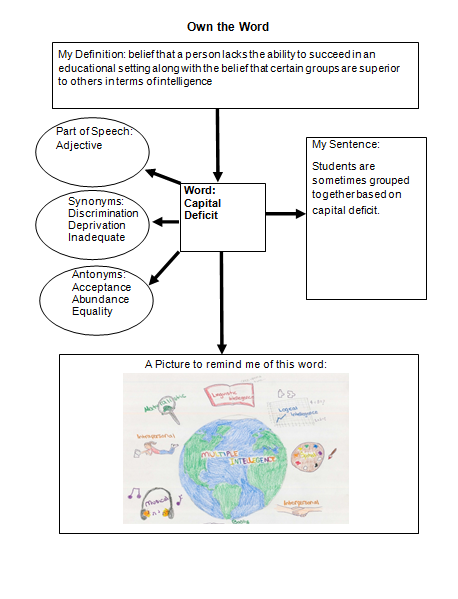
family is poor, his parents are undereducated, the dialect nonstandard, then we
are much more likely to interpret experiential difference as a deficit in the
child, in the parents, and in the sociocultural community within where the child grew
up,” (130). Being that, if the teacher assumes that the child is incapable of
obtaining forms of literacy knowledge, the teacher will show little to no
effort to offer that child a chance to succeed.
Contributing to poor literacy instruction are the
teachers and administrators –who tend to often ignore the issue at hand. For
instance, while reading about Donny, I recall that although unprepared to
further his education at a higher grade level, the teacher as well as the
principal enabled him to advance to the third grade. Fortunately, there was
intervention, but had there been no means of intervention, a student full of promise
would have been advanced to the succeeding grade level each year while still
unable to master the basics of literacy knowledge: reading and writing. Shouldn’t
teachers and administrators spend more time on the quality of one’s education and not just the quantity –being the amount of time not being spent working
with that student in fear that he or she may become a burden to that teacher/administrator
and his or her time.
In a two year study of kindergarten and first-grade
children (Purcell-Gates & Dahl, 1991), Purcell-Gates alongside Karin Dahl “found
that, across the board, these children (from economically stressed homes) had
less knowledge of written language and how reading and writing work than children
from more middle-class homes,” (126). If one is believed to not surpass the
common misconceptions and assumptions made about those of lower-income
families, denial of educational opportunity will occur as a result.
In terms of the relationship between language and
literacy, language can be viewed as nonessential in terms of understanding
literacy. If an individual is language deprived, it will be difficult for him
or her to communicate, thereby, how will literacy occur? If the individual is
given a language (whether spoken or signed), however, he or she will thrive in
terms of literacy, for the two complement each other.
Educators alike are known to have the common assumption
that those who are poor, less education, and/or have nonstandard dialect are
less likely to succeed in terms of furthering their educational opportunities.
As a result, educators often become judgmental towards those students whose
family is poor, is undereducated, and/or whose dialect is nonstandard, offering
them little opportunity to succeed in terms of educational opportunities. To
beat this common assumption and to no longer deny students of educational opportunity,
educators must treat all students equally, no longer making assumptions about
each student based on his or her personal background. If they cannot succeed in
doing so, little to no effort will be offered to those students, resulting in discrepancy
in the each student and an insignificant success rate within the classroom.
Being from northern West Virginia, I didn’t know of
anyone who actually had an accent while in high school. In high school, it was
all about using “Proper English”, so I find the term to be a natural way of
speaking. I was one to grow up amongst people who were conscientious of not
using double negatives or misusing subject-verb agreement, conditional verb
forms, verb participles, or adjectives and adverbs. And honestly, the word “ain’t”
has never been in my vocabulary nor will it ever be. I don’t use slang and try
to pronounce words to the best of my ability. I suppose that because of the
environment in which I first engaged in literacy knowledge and in which I
learned my love for English as a subject and as a language, I prefer to follow
the rules of “Proper English” and often find myself correcting those who do
not. Wednesday, August 22, 2012
Double Entry Journal #1
In the article entitled “Research Review for Inclusive Practices “
by Rita Hocog Inos and Mary Anne Quigley, the definition of inclusion is stated
to be “including all.” Therefore, this new teaching practice could be defined as
including students who have various learning difficulties into the regular
classroom to work with nondisabled students. Moreover, the article states that “the term inclusive schools is generally used
to describe changes that are occurring within schools and school districts to
coordinate and unify educational programs and services and to transform schools
into places where all children, including those with diverse abilities and
needs, belong and can learn at high functioning levels.” The types of students
inclusive education is meant to serve are those who struggle to learn; such
learning difficulties can range from issues such as linguistic troubles,
various socioeconomic levels, mental health issues, and so on and so forth.
A key characteristic of an inclusive school is that parents are partners in the students’ education. According to the article, parent involvement is extremely important, so this is a vital characteristic for success in inclusive education. Another significant characteristic of an inclusive school is the existence of co-teachers in classrooms. When two or more teachers compromise and work together in the classroom, they have more to offer to various students. Hence, this is another vital characteristic for inclusive education.
A strategy that helps students become more responsible and effective in the inclusive process is when there is a sense of unity and community in the classroom. If a student feels as though he/she is part of the classroom whole or the classroom community, he/she will be more responsible in completing tasks and displaying integrity due to the fact that those same characteristics are being shown throughout the whole community of which that student is a part of.
I chose this video because it is a wonderful clip about inclusion.
The focus is on inclusion in education as a new form but one that represents
hope, equality, respect, and collaboration –to live and to work as one.
“Whether the road travels straight or bends to meet the landscape,
the destination must be the same.”
Inos
, R. H. (2012). Research review for inclusive practices. Retrieved from http://www.prel.org/products/Products/Inclusive-practices.htm
Inclusion
in education .
(Feb, 27 2009). Retrieved from http://www.youtube.com/watch?v=GfUqd1fTtgM
Thursday, May 5, 2011
Day 26 - Portfolio
Within this class period, I wrote my reflection pertaining to Self-Renewal under Standard 4.
Click here to view my portfolio
Click here to view my reflection pertaining to self-renewal under Standard 4
ISTE NETS T Standards:
2b. develop technology-enriched learning environments that enable all students to pursue their individual curiosities and become active participants in setting their own educational goals, managing their own learning, and assessing their own progress -in creating my portfolio, I am creating a technology-enriched learning environment that will enable all students to become active participates in setting their own education goals, managing their own learning, and assessing their own progress just as I am doing
2d. provide students with multiple and varied formative and summative assessments aligned with content and technology standards and use resulting data to inform learning and teaching -in this case, my portfolio, once complete, will provide students and other teaching professionals informative information on the ways in which I have addressed the technology standards throughout my time in the Elementary Education program at Fairmont State University
3c. communicate relevant information and ideas effectively to students, parents, and peers using a variety of digital-age media and formats -by creating a portfolio, I am communicating relevant information and ideas effectively to students, parents, and peers, using a variety of digital-age media and formats
Subscribe to:
Posts (Atom)